Overview:
My published work has explored how the surveillance of disease vectors and the COVID-19 pandemic contributed to inequality at both, a global and local scale. As contagious diseases become more common as a result of warming temperatures driven by climate change, understanding who gets to produce knowledge about them, and who is the most vulnerable to them is essential.
Assessing and correcting neighborhood socioeconomic spatial sampling biases in citizen science mosquito data collection — Scientific Reports
Abstract
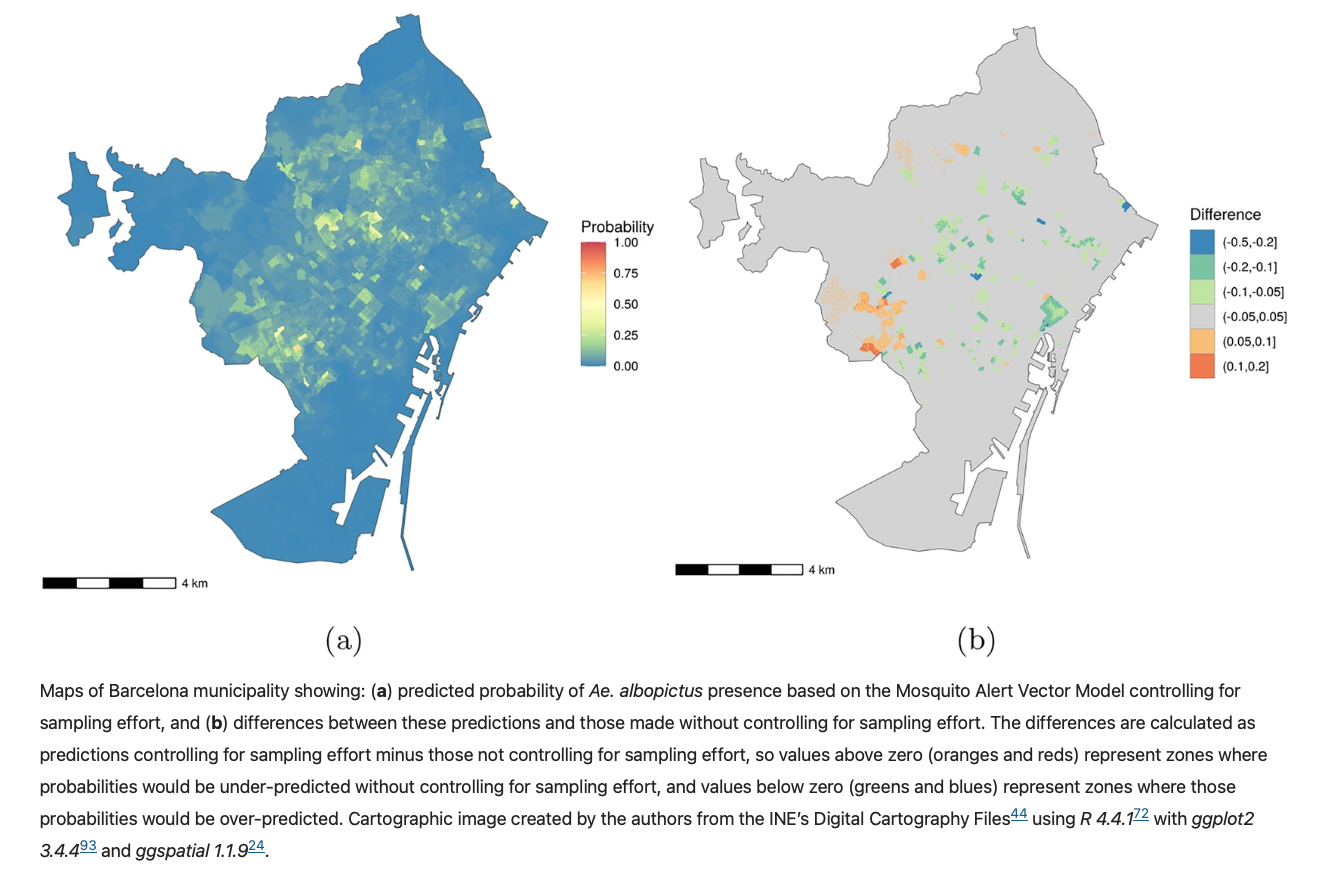
Climatic, ecological, and socioeconomic factors are facilitating the spread of mosquito-borne diseases, heightening the importance of vector surveillance and control. Citizen science is proving to be an effective tool to track mosquito populations, but methods are needed to detect and account for small scale sampling biases in citizen science surveillance. In this article we combine two types of traditional mosquito surveillance records with data from the Mosquito Alert citizen science system to explore the ways in which the socioeconomic characteristics of urban neighborhoods result in sampling biases in citizen scientists' mosquito reports, while also shaping the spatial distribution of mosquito populations themselves. We use Barcelona, Spain, as an example, and focus on Aedes albopictus, an invasive vector species of concern worldwide. Our results suggest citizen scientists' sampling effort is focused more in Barcelona's lower and middle income census tracts than in its higher income ones, whereas Ae. albopictus populations are concentrated in the city's upper-middle income tracts. High resolution estimates of the spatial distribution of Ae. albopictus risk can be improved by controlling for citizen scientists' sampling effort, making it possible to provide better insights for efficiently targeting control efforts. Our methodology can be replicated in other cities faced with vector mosquitoes to improve public health responses to mosquito-borne diseases, which impose massive burdens on communities worldwide. Read the paper
Unique times, unequal mobilities: Daily mobility during the de-escalation of the COVID-19 pandemic — Population, Space and Place
Abstract
Scholars have highlighted drastic reductions in daily mobility during the early stages of the COVID-19 pandemic lockdown. But what happened when restrictions were relaxed though risk remained ubiquitous? How did patterns of mobility change and how were they structured by socioeconomic resources and social roles? We address these questions using a cross-sectional representative sample (n = 2942) of the population of Andalusia, Spain, after a month and a half of severe lockdown in 2020. We find that older people were the least mobile group and that people living with children and in extended households were less likely to move to take care of others, unlike before the pandemic. Men were more likely to carry out daily mobilities for which women had been traditionally responsible, such as care mobilities. Women were also more likely to be immobile and less likely to commute. Finally, manual and nonqualified workers were more likely to commute, but they were just as likely as any other group to carry out other types of mobility. These results highlight the social character of mobility in a unique context. We emphasize the need to disaggregate daily mobility based on different purposes as well analysing how these are practised by different sociodemographic groups if we want to provide rigorous descriptions of a core component of individuals' daily life. Read the paper
Key epidemiological indicators and spatial autocorrelation patterns across five waves of COVID-19 in Catalonia — Scientific Reports
Abstract
This research studies the evolution of COVID-19 crude incident rates, effective reproduction number R(t) and their relationship with incidence spatial autocorrelation patterns in the 19 months following the disease outbreak in Catalonia (Spain). A cross-sectional ecological panel design based on n = 371 health-care geographical units is used. Five general outbreaks are described, systematically preceded by generalized values of R(t) > 1 in the two previous weeks. No clear regularities concerning possible initial focus appear when comparing waves. As for autocorrelation, we identify a wave's baseline pattern in which global Moran's I increases rapidly in the first weeks of the outbreak to descend later. However, some waves significantly depart from the baseline. In the simulations, both baseline pattern and departures can be reproduced when measures aimed at reducing mobility and virus transmissibility are introduced. Spatial autocorrelation is inherently contingent on the outbreak phase and is also substantially modified by external interventions affecting human behavior. Read the paper
What do we know about the impact of economic recessions on mortality inequalities? A critical review — Social Science & Medicine
Abstract
Historically, there has been a debate on the effects of recessions on population health, and especially on mortality and its distribution across different social groups. This paper contributes to this discussion by means of a critical review of the research on the impact of economic recessions on mortality inequalities in the period 1980–2020. We analyzed 19 studies according to their mortality outcomes, socioeconomic indicators, design, analysis, and main findings. Twelve studies focused on European countries or urban areas, two on Asian countries, two on Russia, one on Asia and Europe, one on the USA, and one in Somalia. Five articles included cross-country comparisons (four between European countries or cities and one between Asian and European countries). The Great Recession of 2008 was the most researched economic crisis, followed by country-specific crises in the 90s, the fall of the Soviet Union, and some crises during the 80s. Most studies (n = 15) showed an overall or partial increase in mortality inequalities after an economic recession. However, two papers found a decrease in mortality inequalities due to the worsening of the health of the upper and middle classes, one article found a decrease in inequalities due to a general improvement in population health, and a study found a "slow-down" effect of pre-existent mortality inequalities. Read the paper
Inequalities in COVID-19 inequalities research: Who had the capacity to respond? — PLoS ONE
Abstract
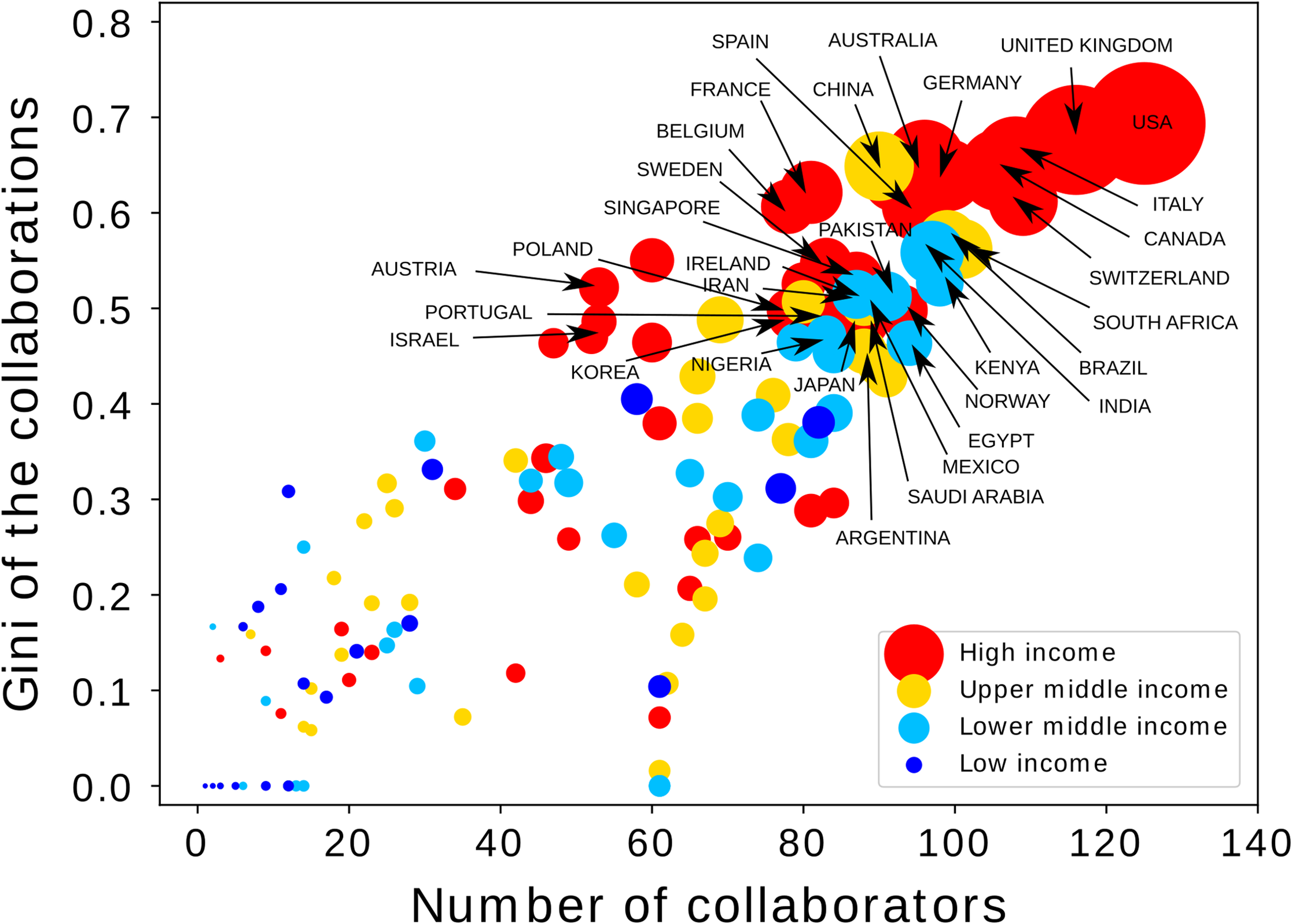
The COVID-19 pandemic has been testing countries' capacities and scientific preparedness to actively respond and collaborate on a common global threat. It has also heightened awareness of the urgent need to empirically describe and analyze health inequalities to be able to act effectively. In turn, this raises several important questions that need answering: What is known about the rapidly emerging COVID-19 inequalities research field? Which countries and world regions have been able to rapidly produce research on this topic? What research patterns and trends have emerged, and how to these compared to the (pre-COVID-19) global health inequalities research field? Which countries have been scientifically collaborating on this important topic? Where are the scientific knowledge gaps, and indirectly where might research capacities need to be strengthened? In order to answer these queries, we analyzed the global scientific production (2020–2021) on COVID-19 associated inequalities by conducting bibliometric and network analyses using the Scopus database. Specifically, we analyzed the volume of scientific production per country (via author affiliations), its distribution by country income groups and world regions, as well as the inter-country collaborations within this production. Our results indicate that the COVID-19 inequalities research field has been highly collaborative; however, a number of significant inequitable research practices exist. When compared to the (pre-COVID-19) global health inequalities research field, similar inequalities were identified, however, several new dynamics and partnerships have also emerged that warrant further in-depth exploration. To ensure preparedness for future crises, and effective strategies to tackle growing social inequalities in health, investment in global health inequalities research capacities must be a priority for all. Read the paper